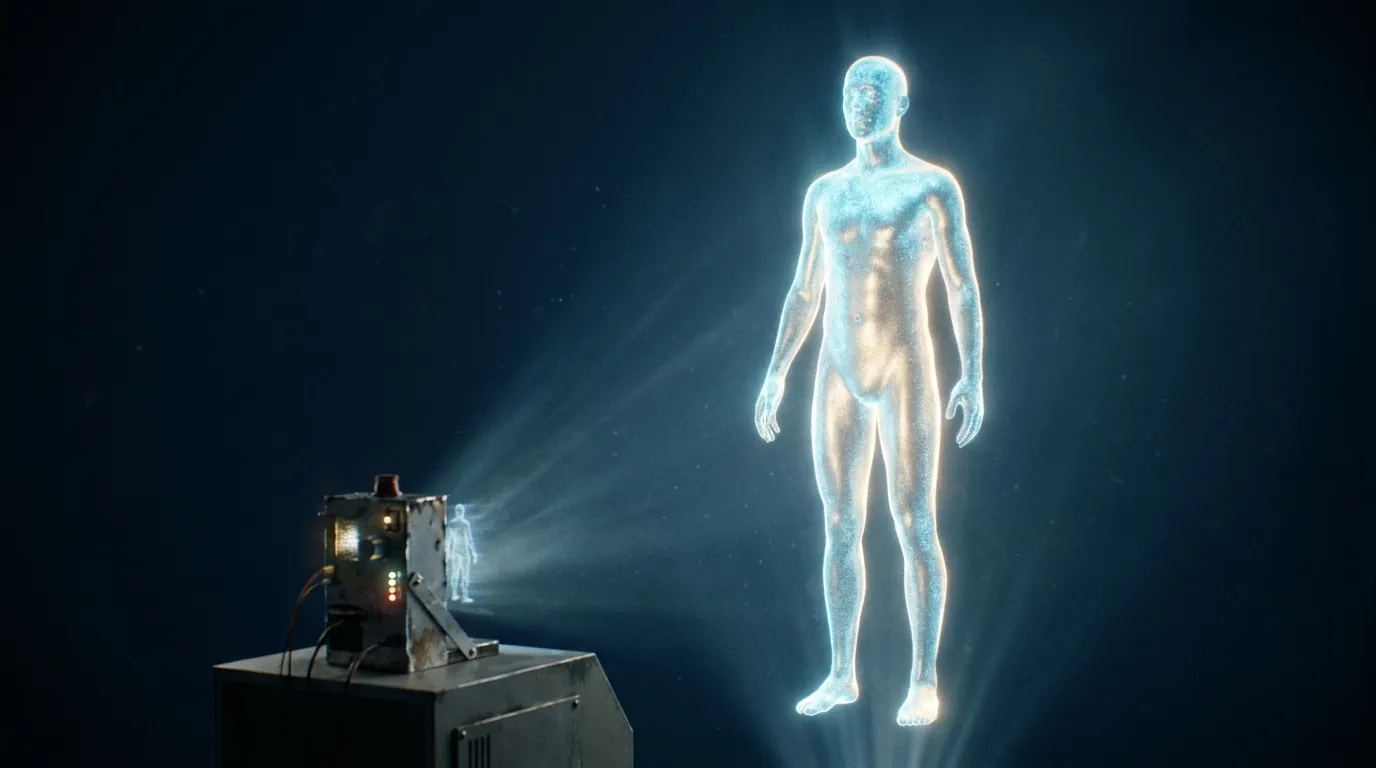
Ahead of the Instrument
The vision arrived complete; the world arrived in instalments — and we chose to describe it as done anyway.
We saw the whole of it before any of it was possible. A stage folded into the air above the living-room floor. A person three thousand miles away standing life-size beside the sofa, at their own height, close enough that you lowered your voice. A dress rendered onto a body that was not there, the hem moving as the body turned. We could draw all of it — the latency, the fall of the light, the way a twin should breathe. Reverse-engineered from 2050 was never a slogan. It was a description of where we were standing.
Then we would turn to the instrument in our hands, and it gave us a fraction. A tenth. The imagination ran years ahead of the silicon, and the gap between them was not abstract. It was a room full of people who had already lived inside the finished thing, blinking at a prototype that stuttered.
We want to be honest about how that felt, because the honesty is the whole point. It was frustrating in a way that does not photograph well. The vision arrived complete and the world arrived in instalments. We would describe a presence that met you across any distance, seamless, under the threshold where the eye catches the lag, and the hardware answered with a heavier, warmer, slower version of the dream. Every demonstration was a translation. Every translation lost something we could see and could not yet hand over.
There is a particular loneliness to being early. You are not misunderstood. You are simply ahead of the evidence. People nod, and mean it, and still cannot feel the thing you feel, because the thing you feel is a memory of a future nobody has built. For a long time the answer to every question was the same. Soon. Not yet. Almost. We said it so often the word wore smooth.
We could have waited quietly. Filed the drawings. Described nothing until the capture stages and the bandwidth and the headsets caught up to the sentences. That is the sensible posture, and we understood its appeal, and we chose against it. We decided to describe the future in the past tense anyway — to write REPLICA as a layer that already moves beneath reality, because in every way that matters to the people who imagined it, it does.
This is the turn we want to make, and we want to make it plainly. Being early is not the same as being wrong. The vision was never the part that failed. The instrument lagged; the sight was accurate. Each year the fraction the hardware can render grows, and it grows toward the same picture we drew at the beginning — not away from it, toward it. The world is walking, slowly, into a room we have already furnished.
So we keep the drawings out where they can be seen. The four realities folding into one. The twin at full height. The concert that materialises in the space where you actually live, motion to photon fast enough that the body believes it. We describe these things as arrived because describing them is how they arrive. The catching-up is the world's work now. The seeing was always ours, and we were not wrong to see it first.