Ad Infinitum
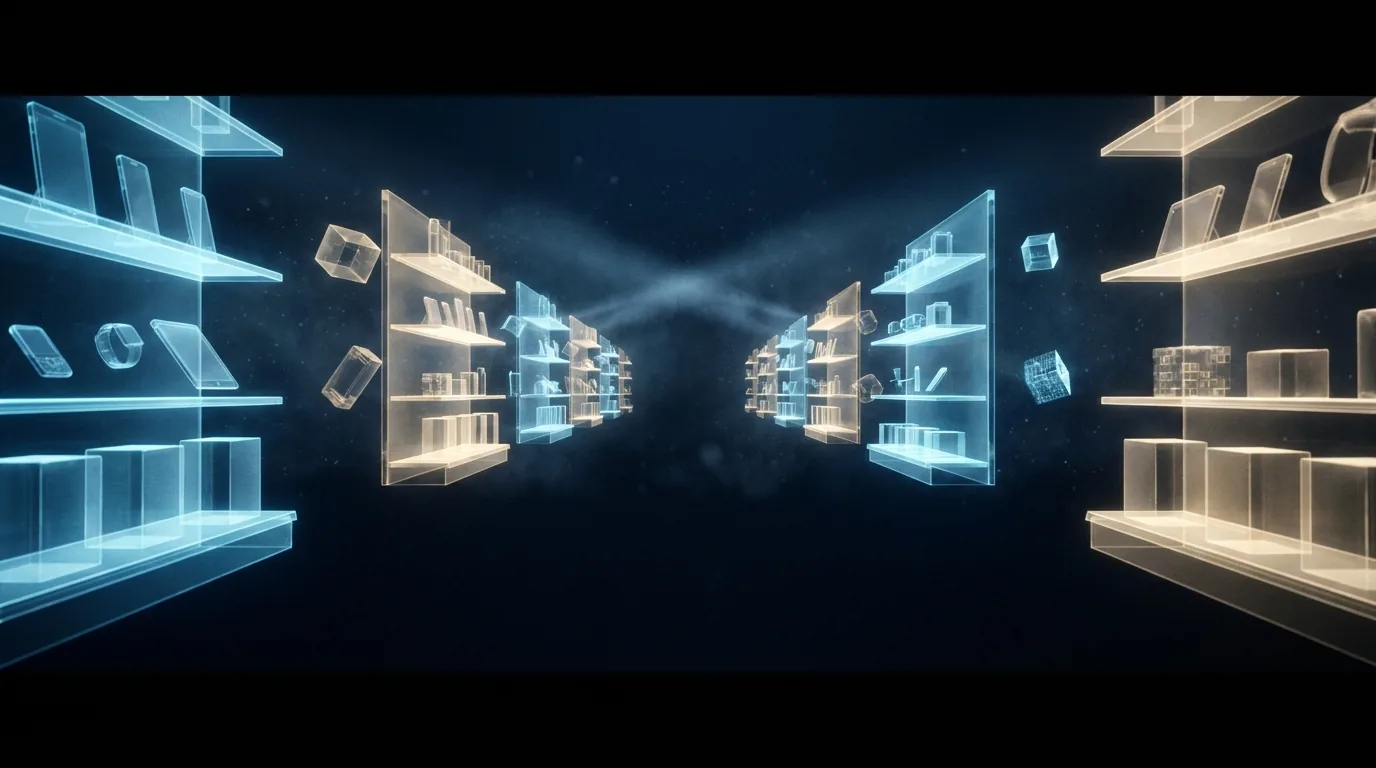
An aisle with no end, in a store that has been freed from the shelf.
Imagine an aisle with no end. Not a warehouse, not a catalogue scrolled on glass — an aisle you walk down on your own two feet, where every object stands at true size in the light, and the aisle keeps offering more the longer you walk, without a shelf running out or a stockroom saying no. Ad infinitum. That is the shape of the Holographic Mega Mall, and we could draw it long before a single wall of it could be built.
Start with the thing it removes. The Mega Mall takes the products off the shelves, the cars off the forecourts, the clothes off the rails, and leaves the building free to be something better than a store: a stream. What appears in front of you is holographic, full-size, turnable in your hands — and what you buy ships to your door from the brand itself. The floor space is no longer a constraint on the range. The range becomes, in the only sense that matters, infinite.
This is the point people miss when they picture a shopping centre with holograms bolted on. The Mega Mall is not a shop that has more things in it. It is a shop that has been freed from the tyranny of physical stock — where the smallest storefront can hold the whole of a maker's catalogue, where a car and a coat and a kitchen can occupy the same square metre at different moments of the same afternoon, because the square metre is a stream and not a shelf.
We described this building for years to people who nodded and pictured a mall. We could specify how the aisle reconfigures, how a single space becomes a boutique at noon and a showroom at dusk, how the whole catalogue of the world could stand in a room that never runs out of room. The idea was complete. The light-field displays that would carry it were not. We kept the aisle open in our sentences and waited for the walls to learn how to hold it.
What the infinite aisle protects, oddly, is the body. Because nothing is stocked, nothing is rushed. There is no pile to clear, no rail to empty, no pressure engineered into the architecture to move you along and move product. The Mega Mall can afford to be patient with a person because it is not fighting for shelf space. Ad infinitum is not only about the size of the range. It is about the room the building can finally give you to decide.
And because the products are light, the mall becomes something a high street has not been for a long time: sustainable. Nothing shipped to sit unsold. Nothing manufactured on a guess. The object stays a possibility until you choose it, and only then does anything real leave a factory. The infinite aisle wastes less precisely because it holds more.
Reverse-engineered from 2050, when the endless aisle is simply how a city shops, and the idea of a shop being limited to what it could physically stack reads as quaint as a market stall. We built the aisle with no end early, in words, and kept walking it until the walls agreed to appear.