The Room, Not the Screen
Presence without a place, and why closing that distance was always the whole point.
We never wanted the screen. Say that plainly, before anything else. The screen was a compromise, a flat surrender we all agreed to make while the real work caught up. For years we sat in front of glowing rectangles and called it being together, and we knew, the whole time, that it was a photograph of togetherness and not the thing itself. What we wanted was the room. Someone in it. Someone who is not there, and is.
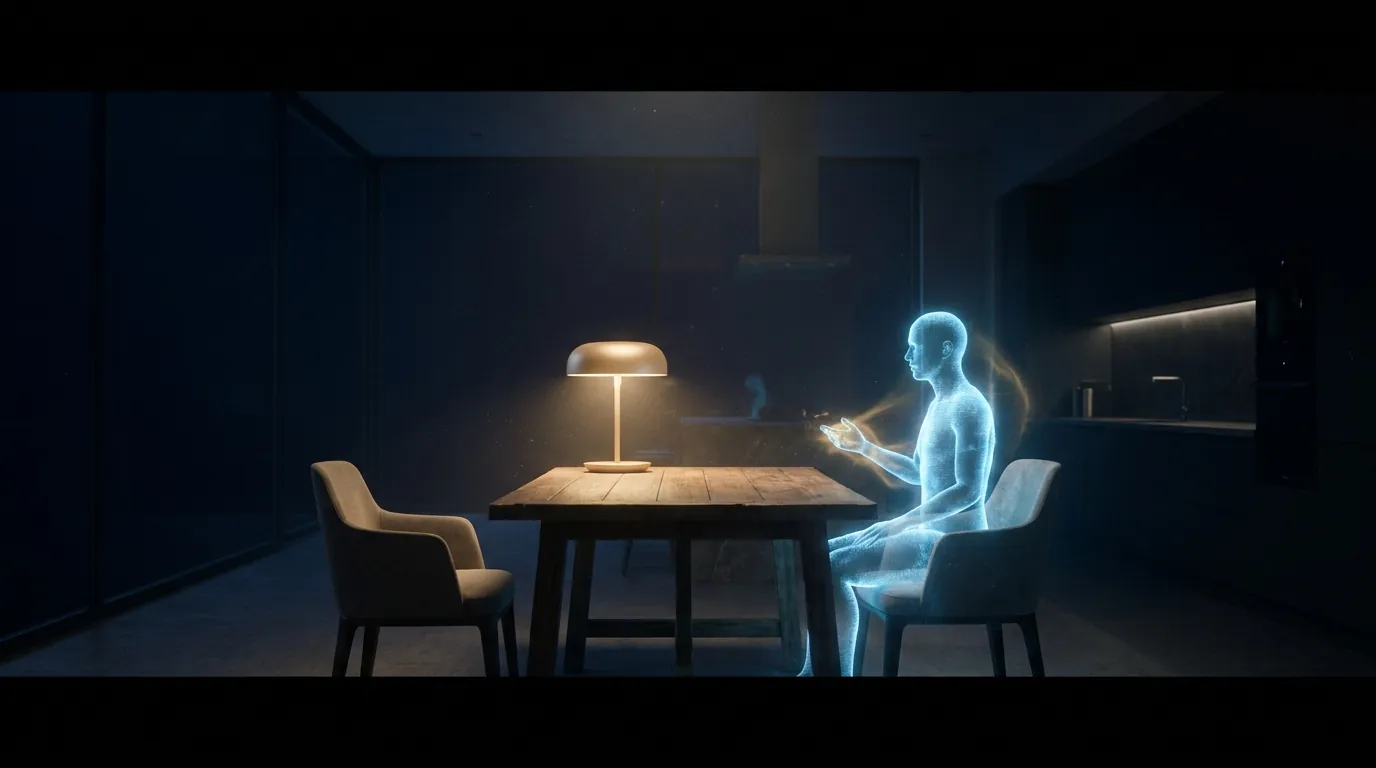
Picture the table. You are on one side of it. On the other side, at full height, in the actual light of your kitchen, sits someone a thousand miles away. Not a window into their room. Yours. The same lamp that falls across the cup in your hands falls across their face. When they lean forward, they lean into your space, and the shadow moves the way a shadow moves. This is what we mean by presence without a place. The distance does not close on a screen. It closes in the room.
For a long time we could describe this and not build it. That is the honest part, the part that cost us something. We could draw the twin, life-size and warm, sitting where the light was right, and then we would look up from the drawing at the hardware in our hands and feel the whole width of the gap. The imagination was already at the table. The silicon was still in the lab. We wrote it down anyway, in the past tense, because describing the future as though it had already arrived was the only way we knew to keep faith with it.
AURA Twin is the answer to a question older than the company. Can you be met? Not paged, not called, not pinged. Met. At eye level, at full scale, close enough that the meeting has weight. Meet XR does not carry a smaller version of you across the distance. It carries you. The presence persists. It waits in the room when you step away, and it is still there, still yours, when you come back.
The thing about a table is that it does not scale down. A face on a screen is always the wrong size, too small to be a person, too flat to be believed. The mind knows. It has always known. What the twin restores is the correct dimension of another human being: the height, the reach, the amount of space a person takes up simply by being in the room. Under two hundred and fifty milliseconds from their movement to your eye, so the leaning-in never lags behind the wanting-to.
This is why every other thing we make points back here. The concert that materialises in your room. The storefront you can walk around. The empathic presence that learns your voice. All of them are versions of the same refusal. We refuse the flat photograph of being together. We refuse the small, wrong-sized substitute. The four realities were never four separate promises. They were four ways of getting a real person back into the room.
Reverse-engineered from 2050, when the screen has long since disappeared and no one remembers agreeing to it. By then the twin is not a feature. It is simply how you sit across from your mother, your collaborator, the person you love who lives in another country, and find that the country counts for less than it used to. The layer beneath reality holds them there, at your table, in your light.
We waited a long time to say this without it being a wish. So we said it as a fact instead, and kept building until the fact caught up. The point was never the technology. The point was the empty chair, and the person who could finally fill it.