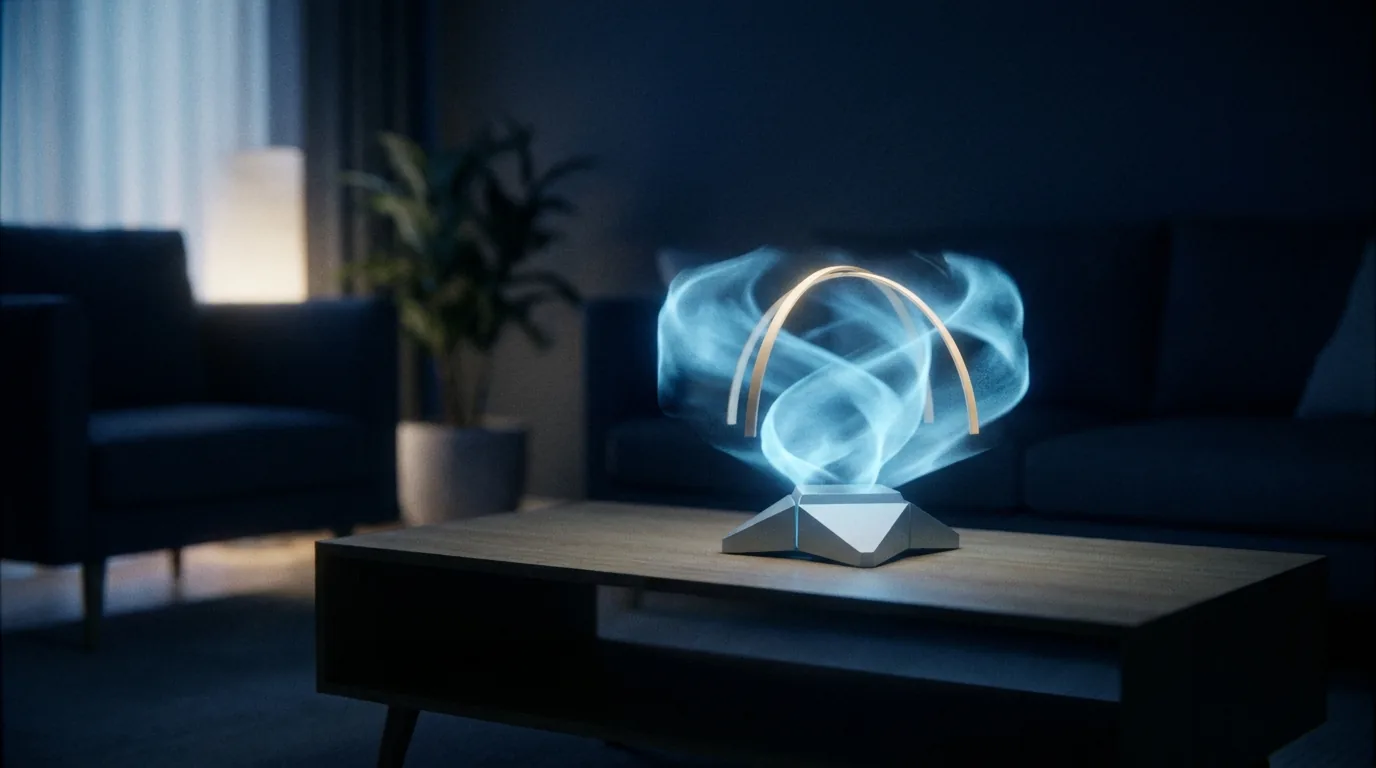
The Advertisement That Asks First
What a storefront made of light must never take from the body in front of it.
There is a version of a spatial advertisement that should frighten everyone, and we have to describe it in order to explain why we refuse it. Picture a message that knows your face, reads your mood, learns what you cannot resist, and arrives in three dimensions in the room where you live, timed to the moment you are least able to say no. A storefront made of light could do that. The question that has haunted this part of the work is what such a storefront must never take from the body standing in front of it.
Spatial Reality Advertisements are unavoidable in a world made of the stream — the value has to flow from somewhere, and attention has always been part of how places pay for themselves. We are not pretending advertising away. We are trying to build the kind that asks first. An advert that arrives by consent, that respects the room it enters, that reads you in order to be relevant rather than to be irresistible — the difference between an offer and an ambush.
We could describe the honest version years before the technology could deliver either kind. The finished principle was simple to state and easy to betray: the advert serves the person, not the other way round. We drew that line in full — and we drew, just as carefully, the line we would not cross: no exploiting the read of a mood, no engineering of the moment of weakness, no turning the empathic layer into a weapon pointed at the person it was meant to serve.
This is where HILLSY's manners matter most. The same emotional resolution that lets a presence sit kindly with someone in grief could, in the wrong hands, notice that grief and sell into it. Same twenty-seven weathers. Opposite souls. An advertising layer that reads your inner weather in order to time its pitch to your lowest moment is not marketing. It is predation with a good render. We built the reader to answer to the person read, not to the highest bidder for their vulnerability.
What a storefront made of light must never take is the body's honesty with itself. It must not make you smaller in order to sell to you, must not manufacture a lack it can then fill, must not turn the mirror against the person looking into it. An advert can be a genuine offer — here is a thing, at true size, that you might actually want. That we will build. An advert that harvests the person is the one thing the light is not allowed to do.
We know how this sounds in an industry that has rarely asked permission. But the whole of our argument is that the spatial web will be too intimate for the old bargain. A flat banner you can ignore. A presence in your living room that knows your face and your mood is a different order of thing, and it demands a different order of restraint. Consent is not a compliance box here. It is the only thing standing between an offer and an invasion.
Reverse-engineered from 2050, when an advertisement that asks first is simply how commerce behaves in a room made of light, and the idea of a message engineered to exploit your weakest moment reads like something a cruder economy briefly allowed. We drew the advert that asks first early — and refused, out loud, to build the one that doesn't.