Reality Will Have a Twin
The screen goes. The counterpart stays. Everything left is a question of when.
We have held one belief longer than any other. Reality will have a twin. Not a copy behind glass, not a window you lean toward and then set down, but a counterpart that stands in the room at full height, holds the light, casts something close to a shadow, and stays when you turn your head. We could see it from the beginning. The seeing was never the trouble. The trouble was waiting for the world to build the parts.
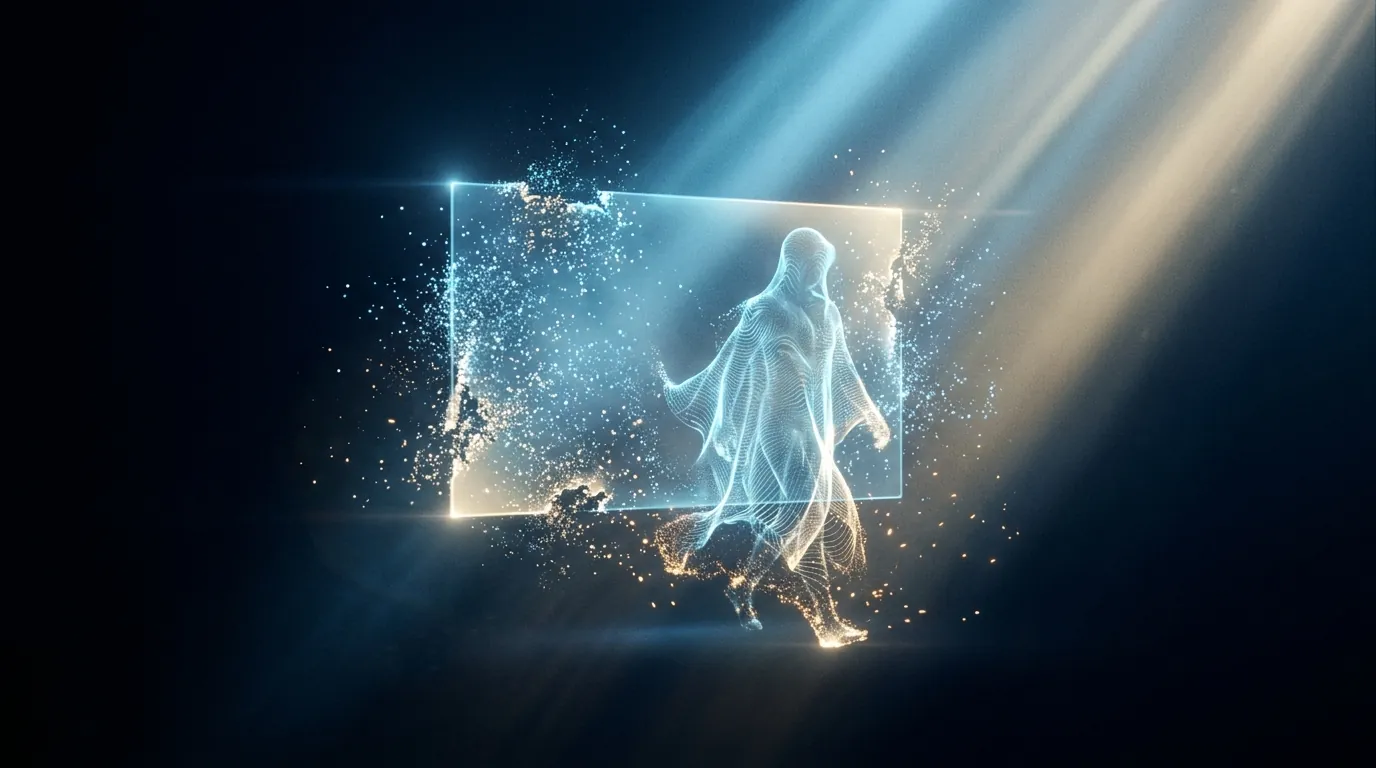
Start with the screen, because the screen is the thing that has to go. For a long time it was a miracle, a lit rectangle that carried faces and cities and the dead back to us. But a rectangle is a border, and a border is a confession. It admits that the thing inside is not here. Every screen ever made has told you the same quiet lie at its edges: this is elsewhere, and you are only watching. The whole history of the medium has been the slow erosion of that edge. And the edge has one place left to go. Away.
When the edge goes, something takes its place. Presence takes its place. This is what gets missed when people argue about the timeline. They imagine the twin as a better picture. It is not a picture. It is a second reality laid over the first, mirrored and seamless, moving as one with the room it borrows. REPLICA is the layer beneath, the spatial stream that keeps the twin honest frame by frame, so that when your friend a thousand miles away turns to look at you, the turn arrives before you can notice it did not.
We say motion-to-photon under 250 milliseconds not as a boast but as a threshold. Below it, the twin stops feeling like a transmission and starts feeling like a fact. Above it, the illusion tears and you remember you are alone. That number is the difference between a performance materialising in your living room and a performance merely projected into it. Between meeting someone across any distance and merely calling them. Presence is a physics problem before it is a poetry one, and we spent years on the physics precisely because the poetry was already finished.
Here is why it is inevitable, argued plainly. Every distance we have ever hated is a distance the twin closes. The grandmother who cannot travel. The concert three continents away. The garment you would try on if only the shop were real and the shop were here. The four realities are not four products. They are four widths of the same gap, and the gap has always wanted to be zero. Technology does not choose whether to close it. Technology chooses only when. Water finds the low ground. The twin finds the empty room.
So the timing was never the interesting question, not even in the years when the timing was the only thing standing between us and everything we had already drawn. The interesting question is the shape. A twin can be built to hold you or to harvest you. It can meet you at eye level, life-size, with the small true weight of another presence in the room. Or it can flatten you into a profile that performs for an audience you cannot see. Same physics. Opposite souls.
That is the work that outlives the wait. We describe the future in the past tense because we have lived inside it long enough to know its manners. What it should feel like to have someone appear in your room and be believed. What an empathic presence owes the person it sits beside. What a storefront made of light must never take from the body standing in front of it. The parts are catching up now, faster than they were. The drawings are still true.
Reality will have a twin. We are no longer asking whether. We are making sure that when it stands up in your room and turns to face you, it is the kind of thing you would have wanted to arrive.