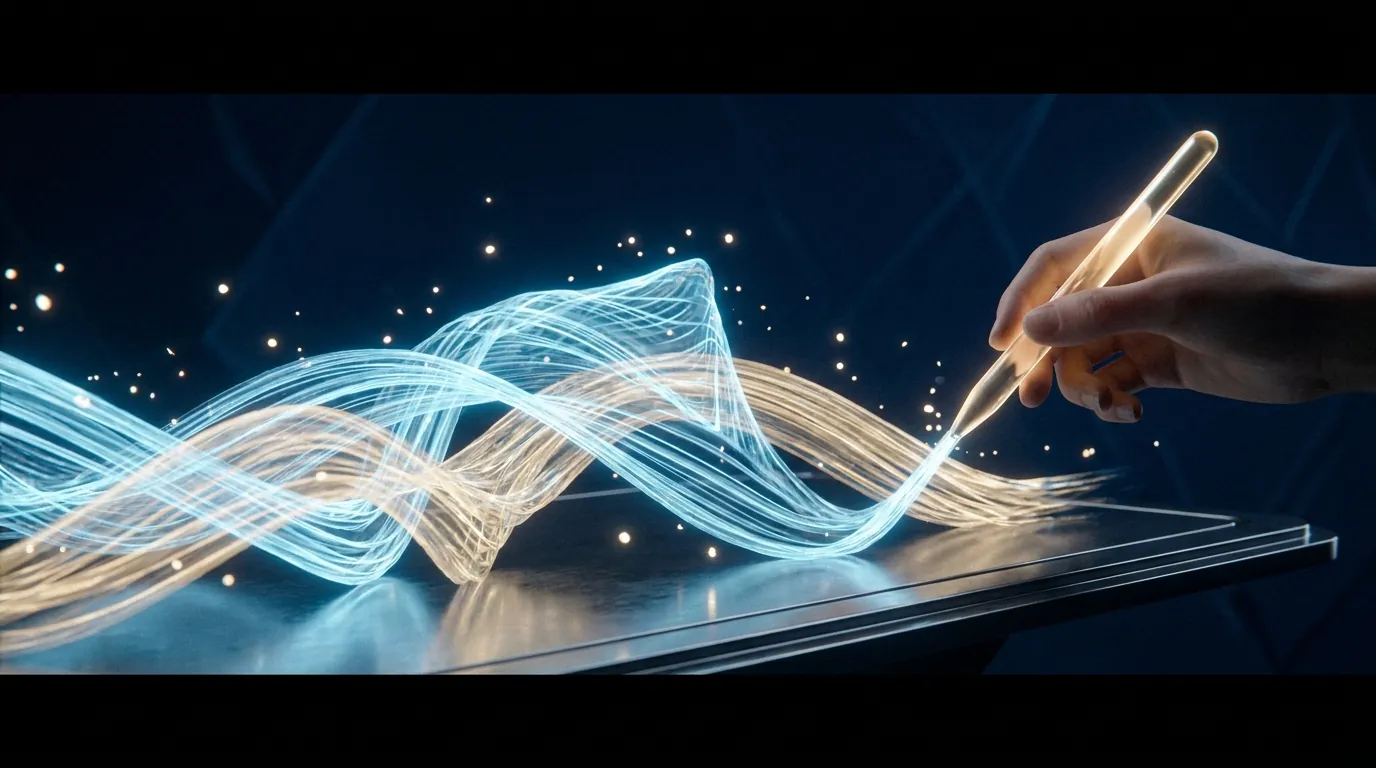
Patience Is a Design Material
On designing honestly for a world that has not arrived yet.
Patience is not a virtue we bring to the work. It is a material we build with. Like glass, like light, like the thin layer of REPLICA that sits just beneath the visible world, it has properties. It bends. It holds tension. It shatters if you load it wrong. For years we designed against it the way a mason works against gravity — not fighting the weight, but making it carry.
The frustration is real and we will not pretend otherwise. We could see the twin standing life-size in the middle of a living room long before any capture stage could hold her there. We described a concert materialising in your own room, the performer close enough to watch her breathe, while the bandwidth to carry that presence did not yet exist. We drew motion-to-photon under 250ms on a whiteboard as the hardware sighed and dropped frames. To imagine that far ahead and be unable to reach out and touch it is a particular ache. We kept drawing anyway.
The dishonest thing would have been to shrink the vision to fit the silicon. To build only what the current headset could render, call it the future, and quietly forget the rest. We refused. The other dishonest thing would have been to demo the impossible as though it were finished — to fake the presence, stage the seam, sell a room that could not yet be built. We refused that too. Between those two lies runs a narrow, honest path, and it is the one we have walked.
So we design in two tenses at once. The present tense is unforgiving and specific: what does the layer actually do today, at this latency, on this glass, in this room. The future tense is where the twin already lives, where AURA Stage is already lit, where Retail XR already lets you stand beside a life-size thing you have not bought yet. We keep both open on the same table. The craft is refusing to let either one lie to the other.
Building for a capability you do not have yet means building the shape of it now. The interaction that will feel inevitable in 2050 has to feel inevitable in the sketch. We model the seamless handoff between virtual and augmented and mixed and in-real-life before the seam can close, so that when the silicon finally arrives it finds a home already waiting, its manners already learned. HILLSY had a temperament long before it had the compute to sustain one. We were designing the welcome for a guest not yet born.
This is where patience earns its place in the toolkit. You cannot rush a material into presence before its time. But you can prepare the room. You can pour the foundations to a tolerance the future will thank you for. You can keep the drawings honest — no promise the layer cannot one day keep, no shortcut that would embarrass us when the world catches up. Every honest sketch is a debt we intend to pay in full.
People believe us, and that belief is the thing we hold most carefully. It is easy to reward faith with spectacle and hope no one checks the wiring. We would rather reward it with the truth in the past tense — describing what we have already built in imagination so precisely that it reads as memory, then doing the slow, unglamorous work of making the memory real. The future was reverse-engineered from 2050. We are only the ones sitting here, patiently, keeping the design honest until the parts arrive.