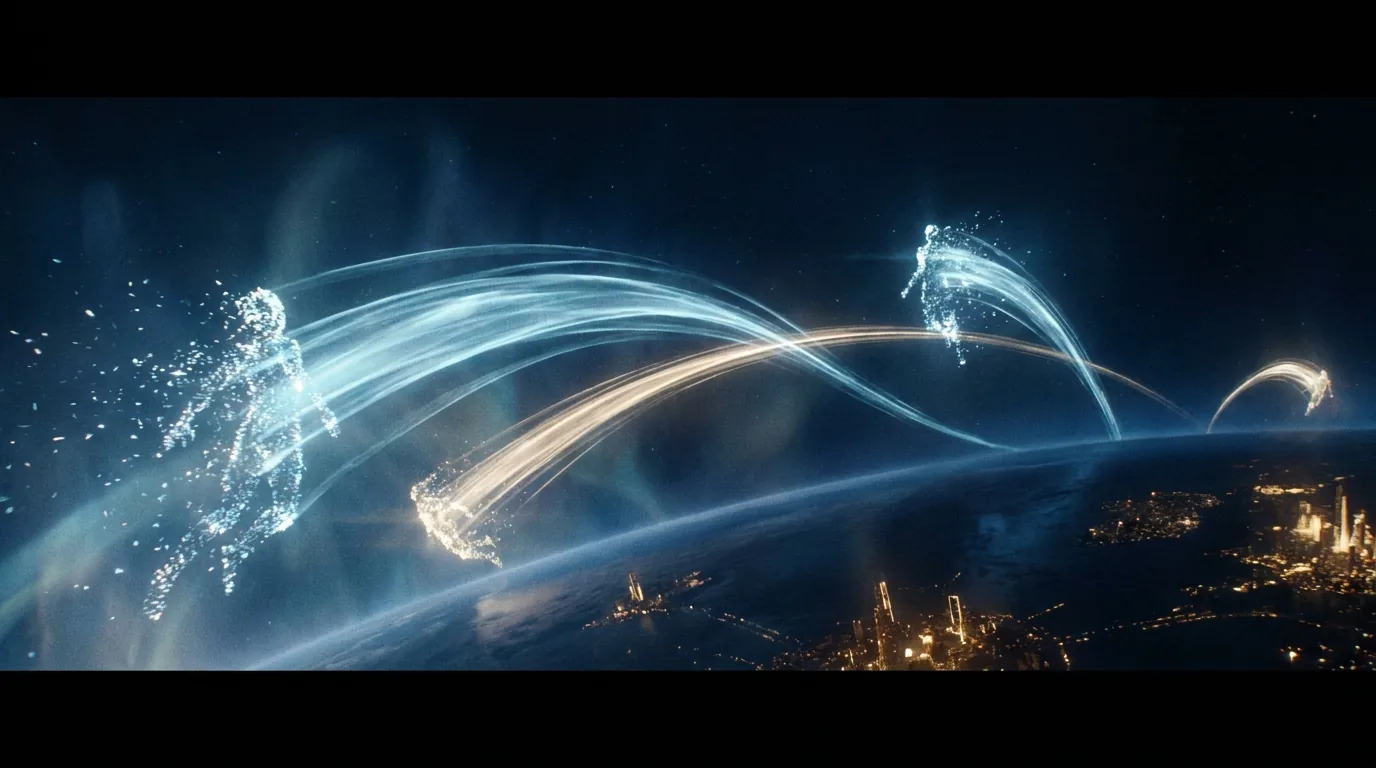
Travellers on Beams of Light
A world that learns to move light instead of matter is a lighter world to live in.
We have a phrase we come back to when the engineering gets heavy and the waiting gets long: travellers on beams of light. It is not a slogan. It is the closest we have come to naming what the whole endeavour is for. A world that has spent its whole history moving atoms — mining them, shipping them, burning them to move bodies and things from one place to another — could learn, instead, to move light. And a world that moves light rather than matter is a lighter world to live in.
Consider the weight of the old way. To put a body in a distant room, we move the body — the aircraft, the fuel, the wake left in the sky. To put a thing in your hands, we move the thing — the factory, the freight, the warehouse of unsold guesses. To keep a person's memory, we hold on to objects. Almost everything we have built as a civilisation is a way of moving or storing matter, and matter is heavy, and the planet has been paying the freight. What if the same ends could be met by moving light?
This is the quiet radicalism underneath the holograms. A presence that travels as light leaves no wake. A product that stays a possibility until you choose it wastes no factory on a guess. A performance that materialises anywhere burns no diesel getting there. We are not building spectacle for its own sake. We are proposing that a great deal of what the world currently achieves by extraction could be achieved, instead, by light — and that this is not a smaller way to live but a lighter one.
We could see this whole argument years before we could demonstrate a minute of it. The finished thesis was always there: the holographic era as a sustainable alternative to a world built on taking. We drew it in full and watched the instruments fall short, and it would have been easy to let the sustainability become a marketing line rather than a governing principle. We chose to keep it governing — to treat every design as answerable to the question of what it moves and what it wastes.
There is a founder's conviction in this that predates the company's ability to act on it. The belief that we are, at our best, travellers on beams of light — that presence, performance, commerce and memory can all be carried by photons instead of freighted by matter — is the thing that made the long wait bearable. We were not just waiting for faster chips. We were waiting for a lighter way for the world to do the things it insists on doing.
So when we say the world is going holographic, we do not only mean the screen disappears. We mean the freight might, too. The meeting without the flight. The store without the warehouse. The concert without the tour convoy. Not everything, not at once — but enough, over time, to matter to a planet that has been carrying the weight of our presence for a very long time.
Reverse-engineered from 2050, when moving light instead of matter is simply the sane thing to do, and the old habit of freighting bodies and objects across the world for every human purpose reads like a heaviness we finally learned to set down. We named ourselves travellers on beams of light early. We are only waiting for the world to feel how much lighter that could be.