Same Space, Same Time
Two rooms a thousand miles apart, made to occupy one set of coordinates.
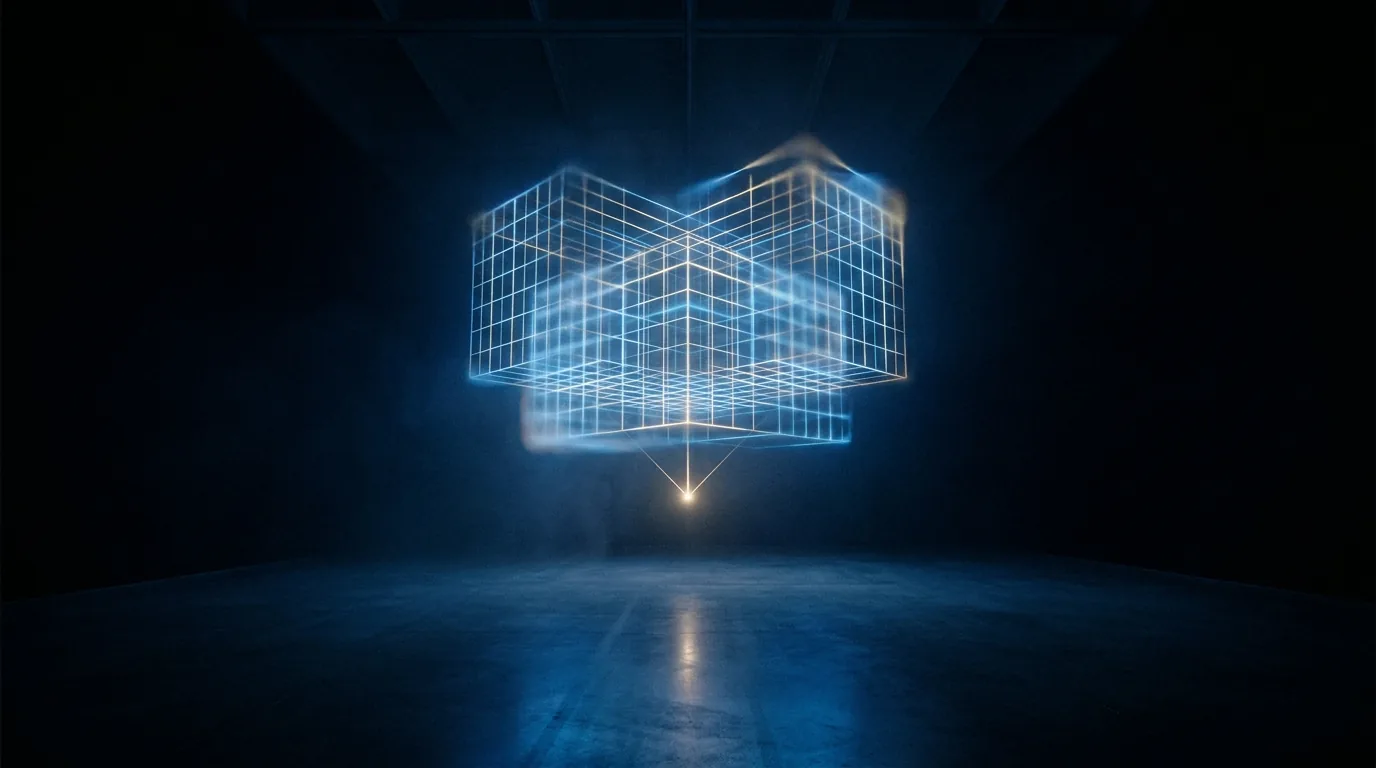
Two rooms, a thousand miles apart, occupying the same coordinates. That is the sentence at the centre of everything, and for a long time it was only a sentence. A room in London and a room in New York, held so precisely in step that a body in one can reach into the other and be there — same length, same width, same height, same moment of time. Four parameters — t, x, y, z — and the whole of the illusion resting on keeping them identical in two places at once.
We call the thing that holds them the Replicated Holographic Quantum Matrix. The name is a mouthful; the job is simple to state and merciless to do. Every location in the stream is represented in the same shared coordinate space, so that two physical rooms can be made to occupy one holographic room — time-synced, quantum-safe, kept honest frame by frame. When it works, distance stops being a subtraction and becomes an overlap. The two rooms are not connected. They are, for the length of the meeting, the same room.
We could describe that overlap years before any matrix could sustain it. The finished idea was always the same: spaces sharing one set of coordinates, a presence stepping cleanly from one into another, the seams where two realities met dissolved into nothing. We drew the shared room in full. The synchronisation that would hold it in step — across continents, against latency, secure enough to trust — was still a diagram. We wrote the overlap down as fact and waited for the mathematics to arrive.
The reason it has to be quantum-safe is not decoration. The moment two rooms share a coordinate space, the layer holding them becomes something worth attacking — presence you could hijack, a room you could forge your way into, a twin you could impersonate at the far end of a call. A matrix that binds the world's rooms together has to be built to survive the world's attempts to break in. We designed the locks before we hung the doors, because a shared space that cannot be trusted is worse than no shared space at all.
There is a beautiful indifference to the matrix once it holds. It does not care which room is larger, which city is which, who arrived first. If a body in a larger space projects into a smaller one, the presence still lands true; the rooms negotiate their differences invisibly. All that matters are the four parameters, kept identical across the gap. Everything human — the meeting, the concert, the supper — rides on top of that arithmetic, believing without ever having to know it is there.
That is the honest shape of the magic. Underneath the twin standing in your room and the concert filling your floor, there is a matrix doing nothing more romantic than keeping two sets of coordinates the same. We spent years on the unromantic part precisely so the romantic part could be believed.
Reverse-engineered from 2050, when rooms across the world routinely share a coordinate and no one thinks about the matrix holding them there, any more than they think about the physics holding up a floor. We described the shared room early. We are only waiting for the mathematics to make the two rooms one.