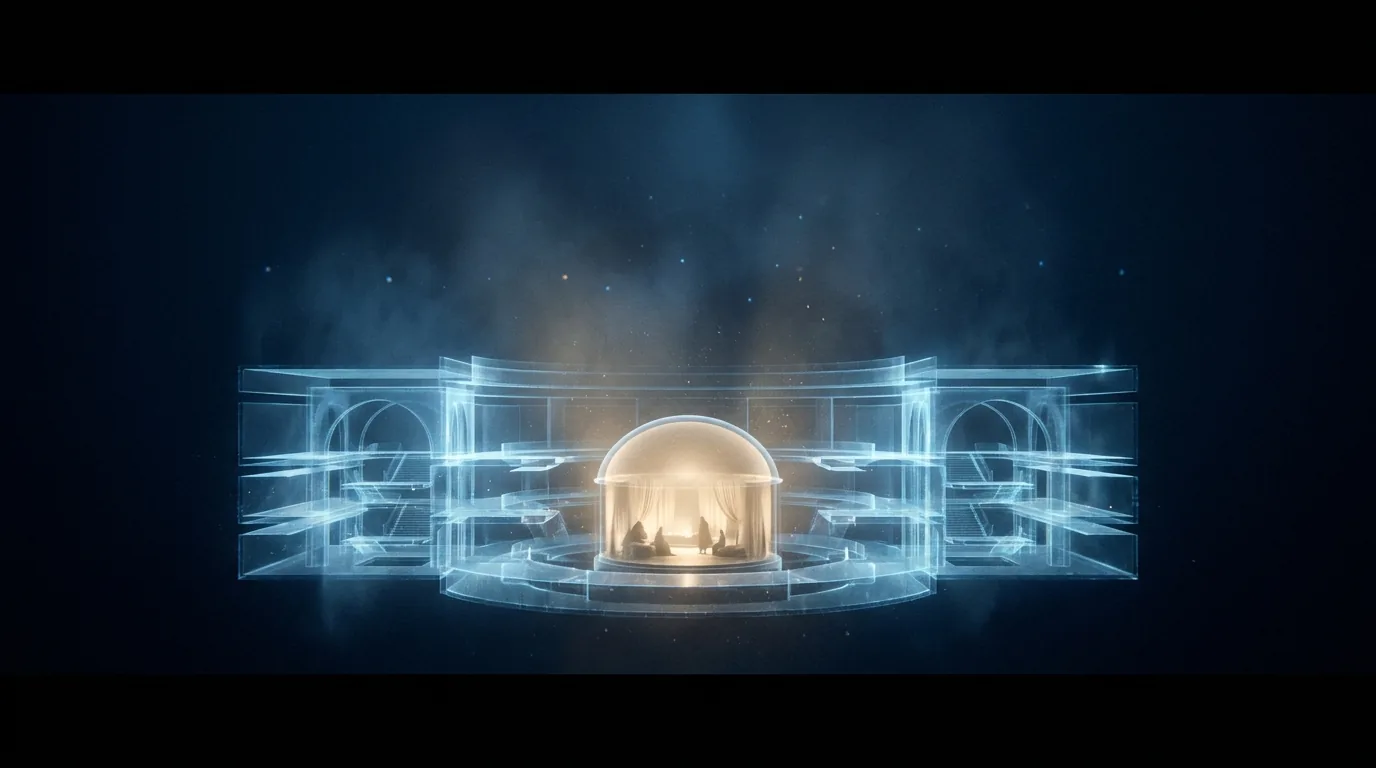
The Building That Breathes
A place engineered to be alive — and taught, first, to be gentle.
A Mega Mall is engineered to be alive. We mean that almost literally. Every surface in it is interactive — the walls, the floors, the ceilings, the partitions between one experience and the next — and every one of them is driven by the layer beneath, so the building is not a backdrop the experiences happen in front of. It is a participant. It notices you. And the first thing we had to design was its restraint.
Here is what makes the building strange: it holds five kinds of visitor at once, in the same room, in step. Someone with no device at all, watching through glassless light-field displays. Someone with a phone, seeing the overlay. Someone in a head-mounted device, standing inside full mixed reality. Someone at home, attending the same building from another country. And the captured layer, recording the public life of the place so a visitor next week can walk through this afternoon. Five widths of presence, one physical asset, all synchronised to the same held moment.
We could describe that synchrony for years before we could hold it. Five modes in lockstep is easy to say and brutal to build — every hologram calibrated to every viewing capability, every visitor's moment matched to every other's, the room's history kept true for the person who arrives late. The design was finished in our heads while the matrix that would keep it in step was still a diagram. We wrote the living building down and waited for it to draw breath.
The hard part was never the spectacle. It was the manners. A building that knows where you are, what you like, who you came with, and what is in your wallet is one bad decision away from a surveillance floor. So we drew the line early and drew it hard: the building's knowing lives with you, not with it. Your identity layer carries your preferences into the room and takes them out again. The processing that recognises you happens on your side of the glass. The Mega Mall gives you the convenience of being known without charging you your privacy for it — because the alternative, the version that harvests the room, is the one thing we refuse to build.
Then there is the building's exhalation. Somewhere inside every Mega Mall there is a quiet room — REFRESH — where the intensity drops, the overlays soften, and a visitor can simply stop. We put it there on purpose. A holographic environment can be too much, and a building that runs every square metre at full engagement is a building designed to exhaust you. The quiet room is our admission that a place this alive needs somewhere to breathe out. Without it, the building is relentless. With it, you can spend a whole day inside and leave restored.
That single decision tells you what kind of building we are trying to make. Not a machine for extracting attention. A place to be somewhere good with other people, richer than the places around it, that hands you back to yourself at the end of the day rather than emptied out.
Reverse-engineered from 2050, when a building that responds to the people inside it is an ordinary kind of architecture — as recognisable as the cinema or the department store once was. We designed the breath before we could build the body, so that when the walls finally woke up, they already knew how to be gentle.