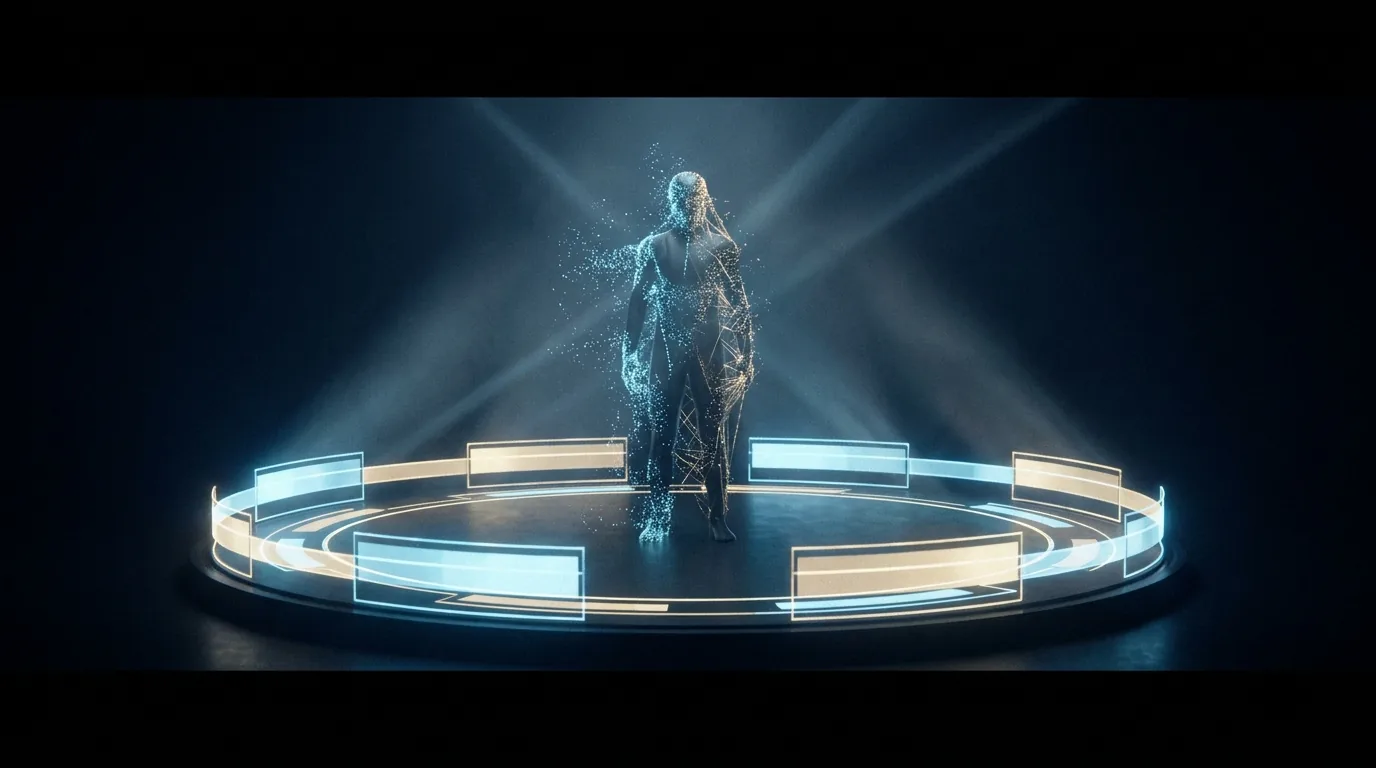
Three Ways to Be Captured
Subject, object, performance — and the permission that comes before all three.
There are three ways to be captured, and we name them plainly: subject, object, performance. A person. A thing. A moment of something happening. Everything that ever appears in the stream — a twin at a table, a coat on a rail, a concert in a living room — begins as one of these three, recorded in a studio built to turn a piece of the real world into light that can travel. We call the studio HOLO Q³, and the first thing it asks you is permission.
Subject capture is a person becoming present-able. Not a photograph, not a scan flattened into a model, but a full holographic record of a body — the way it stands, turns, hesitates, carries its weight — captured with enough fidelity that the twin built from it reads as presence rather than puppet. Object capture is a thing rendered true to size and surface, so the coat drapes and the car reflects and the cup has the right heft in the light. Performance capture is the hardest: a whole event, real and live, recorded so completely that it can materialise anywhere and still be the thing that happened.
We could describe all three for years before a stage could hold any of them. The finished method was clear in our heads — the three captures, the fidelity each demanded, the way a performance recorded once could live on from generation to generation without ever becoming a rerun. The studios that could actually do it lagged behind the description. We wrote the method down as though it were routine and waited for the rooms to be built to match it.
The part we cared about most was never the fidelity. It was the ownership. When you walk into HOLO Q³, the studio does not take your presence. You lend it, on your terms. Your capture, your data, encrypted and yours — you decide who sees it, when, and where, and the location holds nothing of you except what you allow it to hold. We built the consent before we built the cameras, because a technology that captures a person and keeps them is not capture. It is theft with good lighting.
This is where the whole of REPLICA quietly begins. Before a thing can stream, it has to be caught truly and caught fairly. Everything downstream — the twin, the storefront, the concert that outlives the night — inherits whatever honesty or dishonesty was designed into the moment of capture. So we treated that moment as sacred. Catch the subject true. Catch the object true. Catch the performance whole. And never, at any point, catch a person who did not choose to be caught.
Three types of capture, one principle beneath them. What enters the stream should enter it accurately and enter it willingly. The accuracy is an engineering problem, and we have spent years on it. The willingness is a moral one, and we settled it first.
Reverse-engineered from 2050, when being captured for the stream is an ordinary, consented act — as unremarkable as sitting for a portrait once was, and far more faithfully returned. We designed the three captures and the permission they depend on early, so that when the studios finally caught up, they already knew what they were not allowed to take.