The Front Row Has No Seats
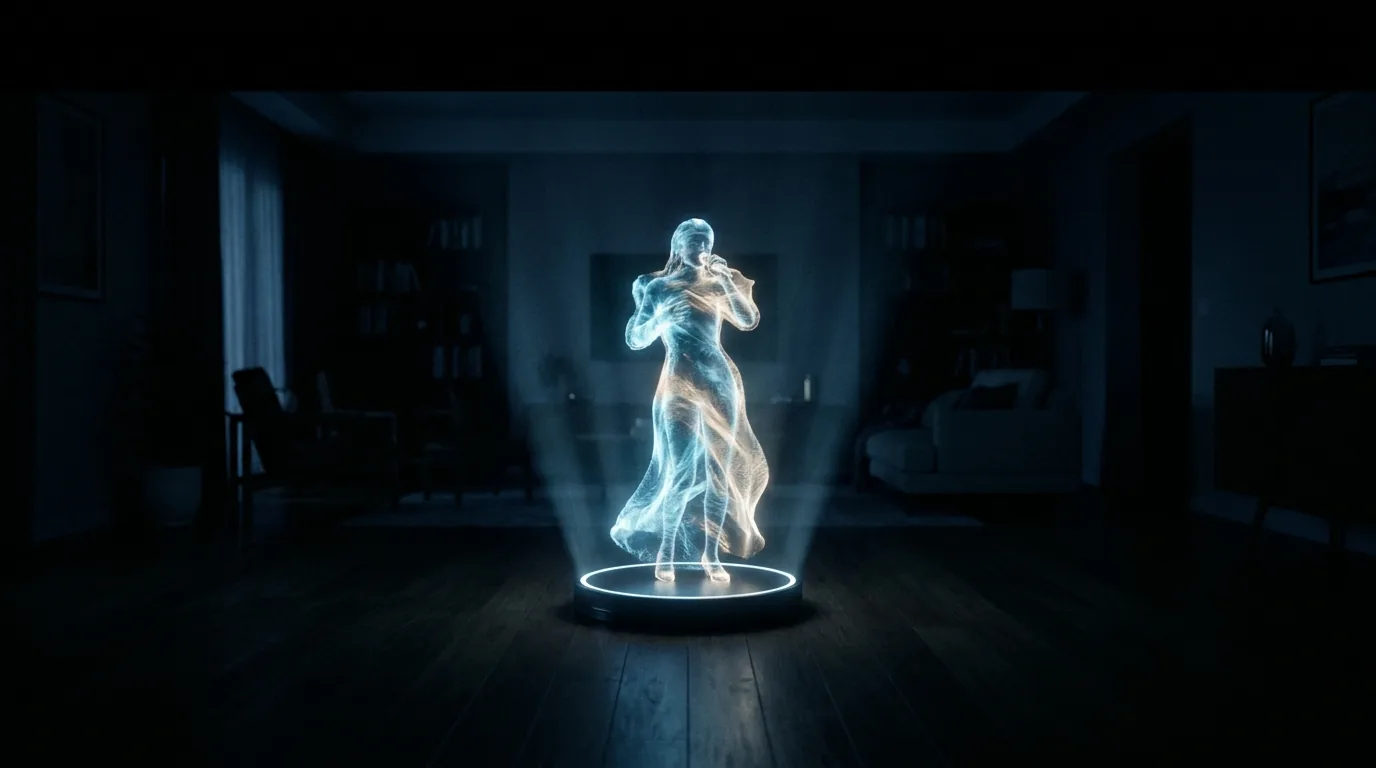
The stage folds down out of the air above your own floor.
The front row has no seats, because the front row is your living room. The stage folds down out of the air above your own floor, the performer close enough that you lower your voice without meaning to, a stadium's worth of moment rendered to the size of a rug and losing none of its size. We have described this concert more times than we can count, to people who pictured a very good screen. It is not a screen. It is a performance that materialises in the room where you actually live.
This is AURA Live, and STAGE XR beneath it, and it is the hardest kind of presence to hold. A person at a table is difficult enough; a performance is a person plus light plus music plus a crowd's worth of energy, all of it arriving live, all of it having to be believed at once. When it holds, the room you know becomes a venue and the artist is there — not projected into your space, present in it, near enough to watch breathe.
We could describe the concert in the living room years before a headset could hold a single bar of it. The finished thing was vivid and complete — the fold of the stage, the fall of the light, the performer materialising near enough to see the effort of the song. We drew it whole. The capture stages and the bandwidth that would carry a body into a room without the seams showing were not ready. We wrote the concert as though it had already happened in a thousand living rooms, because in the only place that mattered, it had.
And we learned the enemy early. It is the dropped frame. A concert can be perfect for four minutes and lose everything in three frames — the moment the presence stutters, the spell tears, and the room remembers it is a room and you are alone in it holding a device. The spell is the whole product. The frames are what break it. Under the threshold where the eye catches the lag, the artist is with you; a hair above it, the artist is a transmission, and the difference between those two things is the difference between the product existing and not.
What we are guarding, in all that ruthless work on latency, is something tender: the belief. The reason to bring a performance into your living room instead of a hall was never convenience. It was intimacy — the artist at the scale of a person rather than a distant figure on a far stage, the song delivered close enough to feel meant. Break the spell and you have neither the intimacy nor the hall. Hold it, and you have something a stadium cannot give: the performance, and the person you love beside you, in the room you both know.
There is a further gift folded in. A performance captured whole does not end when the night does. It can live on, materialising again and again, called out to a new city, a new room, a new generation — real, and live, and once — carried forward without becoming a rerun. The moment happened once. The presence of it need not.
Reverse-engineered from 2050, when the concert in the living room is an ordinary evening and the idea of watching a performance flattened onto a wall reads like listening through a keyhole. We drew the seatless front row early. We are only waiting for the frames to stop falling.